
Realty Time Capsule 1909: The Plan of Chicago Is Released
Introduction
So now we arrive at 1909. What were the events that year that helped shape the United States and its real estate market? Find out in this latest installment of the Realty Time Capsule!
Three Key Points
Before diving deeper, here are the three most important real estate influences of 1909:
- The Release of the Plan of Chicago: This landmark urban planning document introduced ideas that influenced city design, transportation layout, and land-use concepts nationwide.
- Expansion of Organized Real Estate: After the 1908 formation of the National Association of Real Estate Exchanges, 1909 was pivotal for professionalizing real estate practices and establishing ethical and procedural standards.
- Rise of Streetcar Suburbs and Early Zoning Concepts: The rapid expansion of transportation in major cities sparked suburban development, laying the groundwork for later zoning laws and neighborhood planning.
Headline Real Estate News Stories in 1909
If newspapers of the day had a dedicated real estate section, several developments would likely have dominated the headlines:
- Chicago Unveils Visionary City Plan Aimed at Transforming National Urban Design: The Burnham Plan’s release was a major civic event, celebrated as a model for modern city planning.
- Real Estate Boards Grow Nationwide as Industry Seeks Standards and Ethics: The newly formed national real estate organization expanded rapidly, bringing structure to a previously unregulated profession.
- Streetcar Lines Push City Boundaries, Developers Race to Build New Suburbs: Metropolitan areas saw booming subdivision development tied to expanding rail and streetcar systems.
- Cities Adopt Stricter Construction Standards to Improve Safety: Early building codes gained traction, influencing the cost and method of new construction.
These stories captured the nation’s shifting relationship with land, cities, and the rapidly growing real estate industry.
What Historic Real Estate Events Shaped 1909
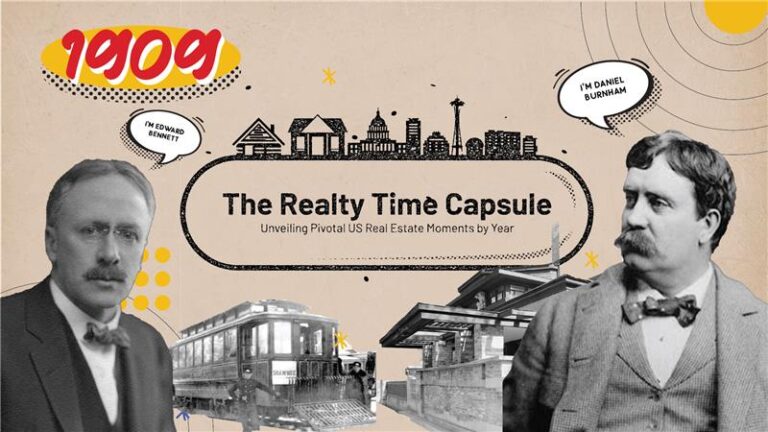
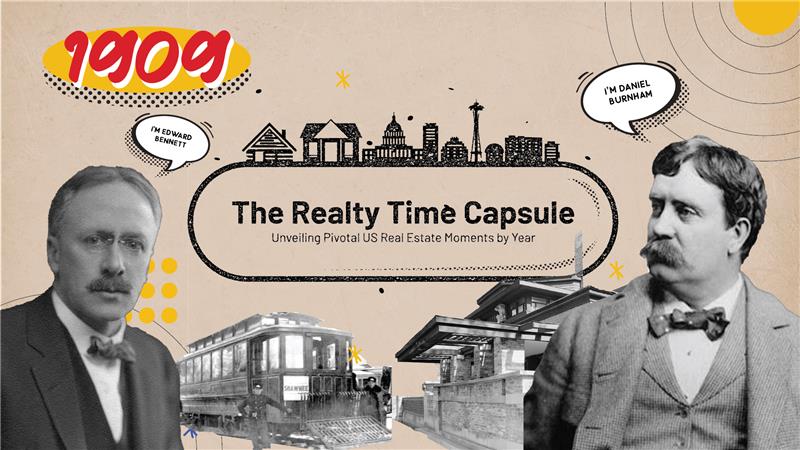
The year’s most defining moment was the release of the Plan of Chicago, authored by Daniel Burnham and Edward Bennett. It was the first comprehensive attempt to rethink an American city as an interconnected, functional whole. More than a beautification project, it introduced visionary concepts such as:
- Integrated street systems
- Waterfront redevelopment
- Civic centers and public spaces
- Rail and highway planning
- Land-use strategies resembling early zoning
Its impact spread beyond Chicago as planners and city leaders across the U.S. adopted its principles. It became the catalyst for the City Beautiful movement, an era of urban beautification and thoughtful design that influenced property values, development patterns, and municipal planning standards.
Meanwhile, the National Association of Real Estate Exchanges, founded just a year earlier in 1908, expanded its membership throughout 1909. This growth marked the beginning of real estate as a professionalized, ethics-driven industry. It set the stage for standardized listings, consistent transaction procedures, and eventually the 1913 Realtor Code of Ethics.
Together, these developments forged a new direction for land use, property transactions, and urban growth in America.
Economic Factors, Supply, and Demand
The economic landscape of 1909 played a critical role in shaping real estate growth. The country was emerging from the effects of the Panic of 1907, which had shaken confidence but also led to banking reforms that increased stability. As financial conditions improved:
- Construction activity resumed
- Land speculation grew, especially in expanding cities.
- Mortgage availability increased, although still far from the modern system created decades later.
Urban populations were growing rapidly, creating strong demand for housing. Developers responded by subdividing land near transportation routes and promoting new neighborhoods as ideal for middle-class families seeking more space and fresh air.
Supply was constrained in certain cities due to limited available land in dense downtown areas, which pushed both residential and commercial development outward. This dynamic set the stage for the suburban expansion that would grow exponentially in the decades to come.
Demographic Factors
In 1909, demographic trends were heavily influenced by immigration and internal migration. Millions of immigrants had arrived in the U.S. in the early 1900s, and many settled in industrial cities such as Chicago, New York, Boston, and Cleveland. This influx created:
- Higher demand for multifamily housing
- Rapid construction of apartment buildings and tenements
- Increased pressure on cities to regulate living conditions
Meanwhile, American-born families, seeking quieter, healthier environments, began moving from dense urban cores to emerging streetcar suburbs. This shift represented one of the earliest examples of suburban migration patterns still seen today.
Societal Preferences and Trends
Society in 1909 was experiencing shifting values related to homeownership, public space, and city life. Some key preferences included:
- Interest in planned neighborhoods with tree-lined streets, sidewalks, and green spaces
- Growing desire for single-family homes away from industrial centers
- Demand for cleaner, more organized cities
These preferences aligned perfectly with the ideals promoted by the Plan of Chicago and the broader City Beautiful movement.
Public enthusiasm also grew for the idea that cities should provide parks, boulevards, and civic architecture that contributed to the quality of life. These societal trends directly influenced land use and property development decisions.
Environmental Factors
Environmental considerations in 1909 looked very different from today’s sustainability-driven mindset, but they still played an important role. The Burnham Plan emphasized:
- Protection of lakefront areas and waterways
- Use of parks as “lungs of the city.”
- Integration of green space into urban development
Cities also started implementing basic sanitation regulations and waste management systems, which improved overall public health and encouraged new investments in real estate.
Additionally, suburban communities promised cleaner air and quieter surroundings, a major marketing point for early homebuilders promoting residential lots along streetcar corridors.
Cultural Factors
The cultural climate of 1909 reflected pride in civic improvement and a belief that a well-planned city could uplift society. The arts, architecture, and civic organizations influenced real estate through:
- Architectural styles such as the Prairie School, championed by Frank Lloyd Wright
- Public demand for beautification, symmetry, and monumental buildings
- Expansion of cultural institutions like libraries, museums, and opera houses
These cultural priorities enhanced neighborhoods, increased land values, and drove cities to adopt long-term planning strategies that affected development patterns for generations.
Transportation and Infrastructure
Transportation was perhaps the single most important driver of real estate growth outside of the Burnham Plan itself. In 1909:
- Streetcar systems were at or near their peak.
- Interurban railroads connected suburbs to city centers.
- Cities began envisioning early forms of highways.
Developers strategically built subdivisions along transit lines, knowing that accessibility increased both land value and buyer demand. These “streetcar suburbs” represented the earliest blueprint for modern suburban development.
Infrastructure investments also enhanced real estate activity, as cities upgraded bridges, roads, and public utilities, many of which followed concepts inspired by the Chicago Plan.
Closing This Realty Time Capsule
As we look back at 1909, it becomes clear that this year was a crucial one for the real estate industry. It was the year when the seeds for modern real estate practices, city planning, suburban growth, and the professionalization of the industry were sown. The Plan of Chicago remains one of the most influential documents in American real estate history, and its principles still resonate in the design and development of cities today.
Looking back, 1909 was indeed a transformative year. From expanding transit lines to evolving consumer expectations and the rapid growth of real estate organizations, they were all in 1909. Knowing and understanding it not only enriches our appreciation of American real estate history but also helps us recognize how the past continues to shape the homes, neighborhoods, and communities we build today.
For a deeper understanding and look into these topics, check out these titles:
The Plan of Chicago:
- “The Plan of Chicago: Daniel Burnham and the Remaking of the American City (Chicago Visions and Revisions)” by Carl Smith